


Humanitarian action involves immediate emergency actions that address significant needs for protection, health, water, hygiene and sanitation that emerge as a result of either a conflict or disaster.
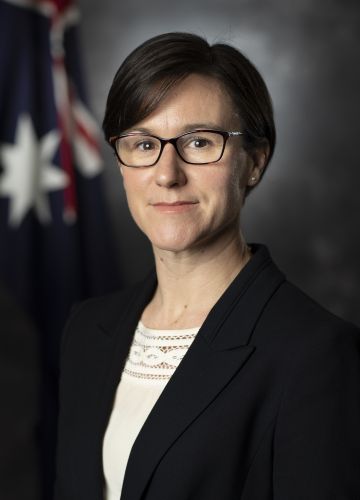
Director General
Nicola Rosenblum
The position of ACMC Director General is provided by the Department of Defence, but serves a whole of government mandate.
Article date
The Indo-Pacific is the world’s most disaster-prone region. The increasing frequency and severity of natural disasters requires government agencies, militaries and NGOs to consider how they can better prepare and respond to crises together.
Published
Australian Guidelines for the Protection of Civilians
A whole-of-government perspective on the Protection of Civilians (POC) in international situations of armed conflict and other situations of violence.
National Action Plans on Women, Peace and Security - Eight Countries in Focus
The purpose of this report is to identify the lessons learned and emerging best practices of UN Member States committed to the implementation of this agenda through National Action Plans (NAPs).
Published
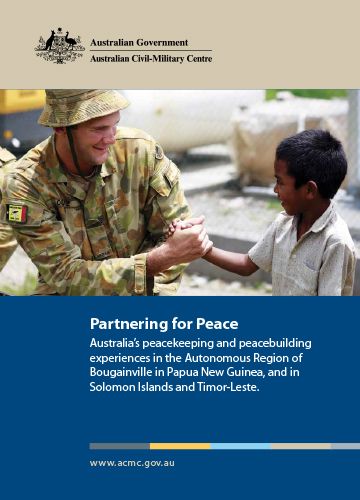
Partnering for Peace
Australia’s peacekeeping and peace-building experiences in the Autonomous Region of Bougainville in Papua New Guinea, and in Solomon Islands and Timor-Leste.
Published
Organising for Peace Operations: Lessons Learned from Bougainville East Timor and the Solomon Islands
Identifying the organisational structures that were developed for each of three operations in Bougainville, East Timor, and the Solomon Islands.
Published
Civil-Military-Police Coordination in Disaster Management: Perspectives from South East Asian countries Research paper and Stakeholder Guide
Responders to natural disasters face increasingly complex operating environments, characterised by new challenges and new actors. Global trends that are overwhelming the international humanitarian system come into sharp focus in South-East Asia.
Published
Wikis and Knowledge Management in Complex Emergencies
The Communication and Complex Emergencies Project is a multi-phase collaboration between the University of Adelaide’s Applied Communication Collaborative Research Unit and the Australian Civil-Military Centre.
Article date
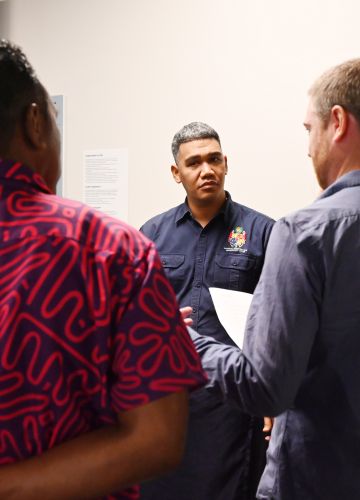
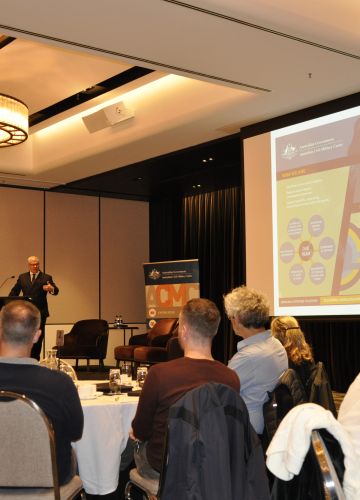
Public servants from the Australian and New Zealand governments, and civil society personnel attended the two-day Civil-Military-Police Interaction Workshop (CMPIW) in Canberra on 18 and 19 June. The aim of the CMPIW was to build capacity and knowledge among mid-career professionals by exposing delegates to a range of tools, exercises and case studies on civil-military-police coordination.