


Humanitarian action involves immediate emergency actions that address significant needs for protection, health, water, hygiene and sanitation that emerge as a result of either a conflict or disaster.
Published
Gendered Crises, Gendered Responses
The Necessity and Utility of a Gender Perspective in Armed Conflicts and Natural Disasters: An Introductory Overview.
Published
Social Media in Complex Emergencies: A Rapid Guide
The Communication and Complex Emergencies Project is a multi-phase collaboration between the University of Adelaide’s Applied Communication Collaborative Research Unit and the Australian Civil-Military Centre.
Published
Civil-Military-Police Coordination in Disaster Management: Perspectives from South East Asian countries Research paper and Stakeholder Guide
Responders to natural disasters face increasingly complex operating environments, characterised by new challenges and new actors. Global trends that are overwhelming the international humanitarian system come into sharp focus in South-East Asia.

Director, Partnerships and Preparedness
Maryann Horne
The Directorate of Partnerships and Preparedness builds and fosters relationships with government and non-government stakeholders, using the work of ACMC to influence better policy and advocate for civil-military collaboration in that community.
Published
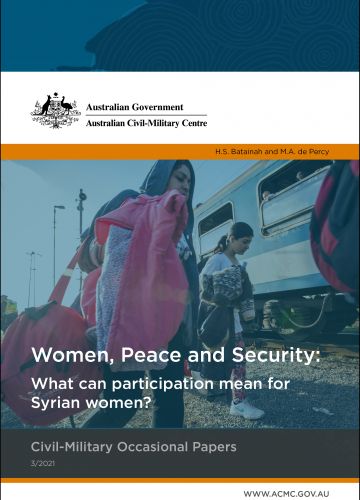
Women, Peace and Security; What can participation mean for Syrian women? - Civil-Military Occasional Papers 3/2021
Between November 2018 and November 2019, the primary author conducted in-depth semi-structured interviews with 100 Syrian women in Jordan and Lebanon – host countries for large numbers of Syrian refugees (along with many Palestinian and Iraqi refugees) – and in Australia. The women were between the ages of 18 and 63; most were in their 30s and 40s. The primary author also interviewed people working with Syrian refugees in Jordan and Lebanon.
Published
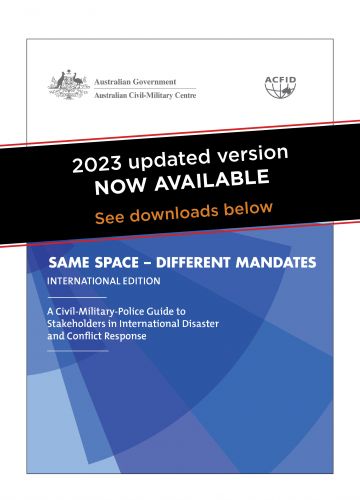
Same Space - Different Mandates (International Edition)
A Civil-Military-Police Guide to Stakeholders in International Disaster and Conflict Response.
Article date
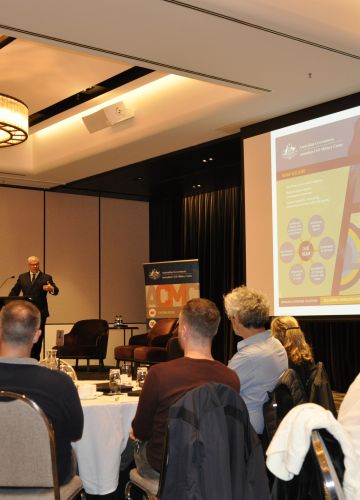
Public servants from the Australian and New Zealand governments, and civil society personnel attended the two-day Civil-Military-Police Interaction Workshop (CMPIW) in Canberra on 18 and 19 June. The aim of the CMPIW was to build capacity and knowledge among mid-career professionals by exposing delegates to a range of tools, exercises and case studies on civil-military-police coordination.
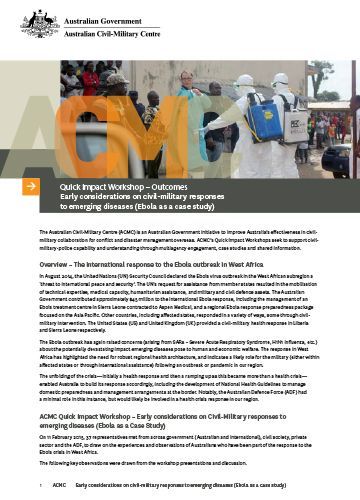
Quick Impact Workshop – Outcomes Early considerations on civil-military responses to emerging diseases - Ebola as a case study
In August 2014, the United Nations (UN) Security Council declared the Ebola virus outbreak in the West African subregion a ‘threat to international peace and security’. The UN’s request for assistance from member states resulted in the mobilisation of technical expertise, medical capacity, humanitarian assistance, and military and civil defence assets.