


Leadership is less a process and more a culture. By empowering people to take ownership of their work, we can expect them to realise their full potential to accomplish their jobs and to be as innovative as possible.
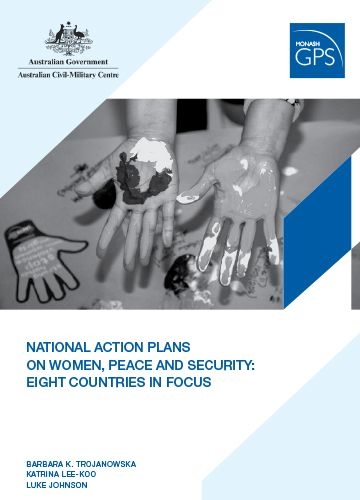
National Action Plans on Women, Peace and Security - Eight Countries in Focus
The purpose of this report is to identify the lessons learned and emerging best practices of UN Member States committed to the implementation of this agenda through National Action Plans (NAPs).
Published
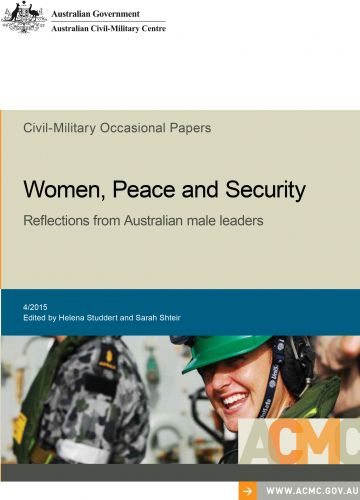
Women, Peace and Security: Reflections from Australian male leaders
Moving past the theoretical by drawing together the real-life experiences, reflections and lessons of male leaders from the Australian Defence Force, the Australian Federal Police and civilians.
Published
Conflict-related Sexual and Gender-based Violence
An introductory overview to support prevention and response efforts.

Article date
As part of an official visit organised by the International Policy Division, the ACMC was honoured to host the Royal Cambodian Armed Forces (RCAF) White Paper Team.
Published
ASEAN-Australian Women, Peace and Security Dialogue
The United Nations’ Women, Peace and Security (WPS) agenda has emerged over the past decade and a half as a significant cross-cutting thematic program for achieving global peace and security.

Article date
The Australian Civil-Military Centre conducted a Civil-Military Interaction Workshop (CMIW) at the Australian Institute of Police Management in Manly, New South Wales in March 2017.
Published
Gendered Crises, Gendered Responses
The Necessity and Utility of a Gender Perspective in Armed Conflicts and Natural Disasters: An Introductory Overview.
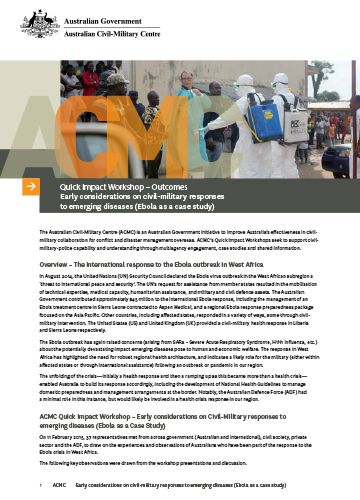
Quick Impact Workshop – Outcomes Early considerations on civil-military responses to emerging diseases (Ebola as a case study)
In August 2014, the United Nations (UN) Security Council declared the Ebola virus outbreak in the West African subregion a ‘threat to international peace and security’. The UN’s request for assistance from member states resulted in the mobilisation of technical expertise, medical capacity, humanitarian assistance, and military and civil defence assets.
ACMC Newsletters
All editions available for download below