
What is the value of diversity in response efforts?
Article date
The Australian Civil-Military Centre (ACMC) is following whole-of-government guidance from the Australian Department of Health and the Prime Minister’s Office in relation to COVID-19, and is monitoring the situation with a priority on the health and wellbeing of its staff and of the general community.
Published
Australian National Action Plan on Women, Peace and Security 2012-2018
The National Action Plan sets out what Australia will do, at home and overseas, to integrate a gender perspective into its peace and security efforts, protect women and girls’ human rights, and promote their participation in conflict prevention, management and resolution. ACMC has a role in the design and implementation of this plan.
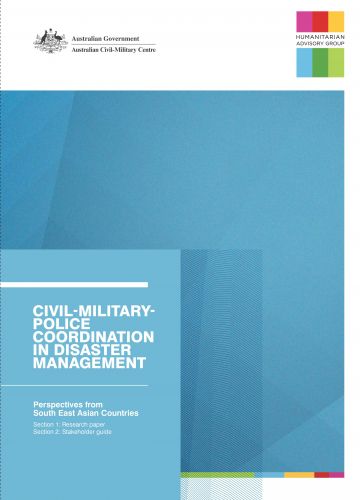
Humanitarian Civil-Military Coordination in Emergencies: Towards a predictable Model
A focus on the coordination of operational planning between civilian and military actors in priority countries in the region–Bangladesh, Nepal, Indonesia, Myanmar and the Philippines.
Published
Social Networking, Social Media and Complex Emergencies: an Annotated bibliography
The role that new media and communications technologies have played in the recent ‘Arab Spring’ uprisings, as well as in recent disaster responses, has sparked a large amount of academic and professional interest.
Published
Wikis and Knowledge Management in Complex Emergencies
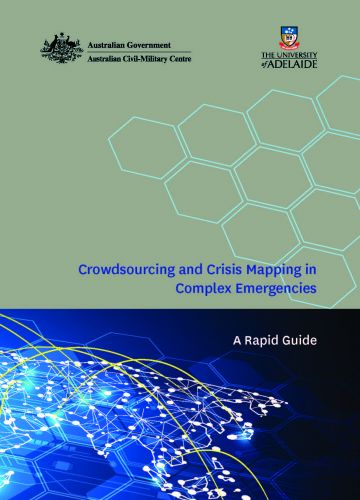
The Communication and Complex Emergencies Project is a multi-phase collaboration between the University of Adelaide’s Applied Communication Collaborative Research Unit and the Australian Civil-Military Centre.
Discuss the importance of innovation in responding to international crises.
Article date
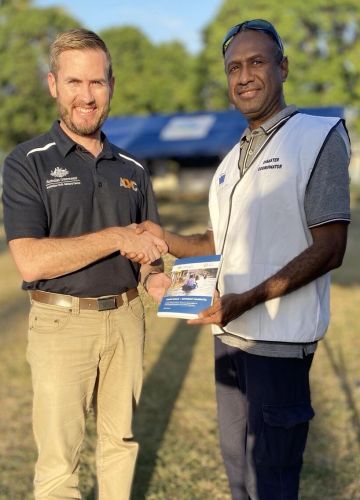
ACMC has maintained a strong working relationship with the Solomon Islands National Disaster Management Office through support to various exercises and activities in recent years, including the last NERT Induction Course in 2023
Quick Impact Workshop – Outcomes Early considerations on civil-military responses to emerging diseases (Ebola as a case study)
In August 2014, the United Nations (UN) Security Council declared the Ebola virus outbreak in the West African subregion a ‘threat to international peace and security’. The UN’s request for assistance from member states resulted in the mobilisation of technical expertise, medical capacity, humanitarian assistance, and military and civil defence assets.