
Humanitarian action involves immediate emergency actions that address significant needs for protection, health, water, hygiene and sanitation that emerge as a result of either a conflict or disaster.
Published
Antarctica 2050: Strategic Challenges and Responses
New Zealand and Australia’s national interests are commonly served by sustaining the peaceand security of the
Antarctic continent. Our shared national security interests are best met by an Antarctica that remains free of military competition.
Published
Women, Peace and Security: Reflections from Australian male leaders
Moving past the theoretical by drawing together the real-life experiences, reflections and lessons of male leaders from the Australian Defence Force, the Australian Federal Police and civilians.
Published
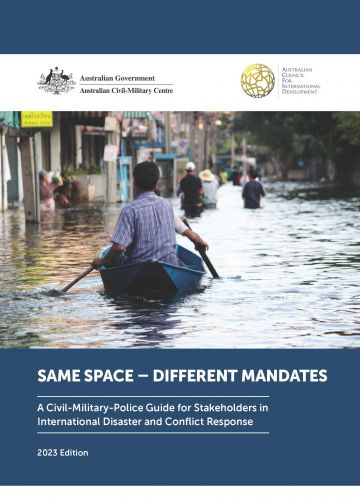
Same Space - Different Mandates
Same Space – Different Mandates aims to improve the collective understanding of civil, military and police stakeholders responding to international disasters and complex emergencies. This revised 2023 edition incorporates emerging concepts and practice to ensure accuracy and future value.
Published
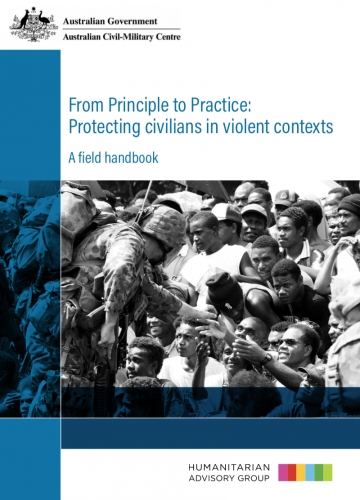
From Principle to Practice: Protecting civilians in violent contexts
Following on from the ACMC Australian Guidelines for the Protection of Civilians (2015) this handbook aims to provide the ‘what’, the ‘why’ and the ‘how’ of protecting civilians in violent contexts and is intended for people working at the operational level including government, NGOs, UN and other organisations.

Article date
ACMC Assistant Director Lessons, Rob Graham facilitated working group discussions, along with members of the ADF, DFAT and AFP, New Zealand MFAT and NZDF.
Published
Crowdsourcing and Crisis Mapping in Complex Emergencies
The Communication and Complex Emergencies Project is a multi-phase collaboration between the University of Adelaide’s Applied Communication Collaborative Research Unit and the Australian Civil-Military Centre.
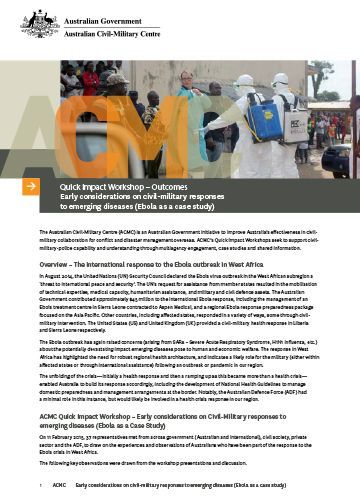
Quick Impact Workshop – Outcomes Early considerations on civil-military responses to emerging diseases - Ebola as a case study
In August 2014, the United Nations (UN) Security Council declared the Ebola virus outbreak in the West African subregion a ‘threat to international peace and security’. The UN’s request for assistance from member states resulted in the mobilisation of technical expertise, medical capacity, humanitarian assistance, and military and civil defence assets.
Published
Gendered Crises, Gendered Responses
The Necessity and Utility of a Gender Perspective in Armed Conflicts and Natural Disasters: An Introductory Overview.