Why is exploring leadership in international response efforts important for improving civil-military-police interaction?
Published
Partnering for Peace
Australia’s peacekeeping and peace-building experiences in the Autonomous Region of Bougainville in Papua New Guinea, and in Solomon Islands and Timor-Leste.
This video discusses safety, security and self-sustainment of international responders and the importance of establishing links with the local population.
Published
Australian National Action Plan on Women, Peace and Security 2021-2031
We need the powerful outcomes generated by the United Nations Security Council’s Women, Peace and Security agenda to assist us as we reconstitute our societies and institutions, and as we resist the temptation to allow conflict to take root in the uncertainty we are all facing.
What does the future of civil-military-police response effort look like?
Article date
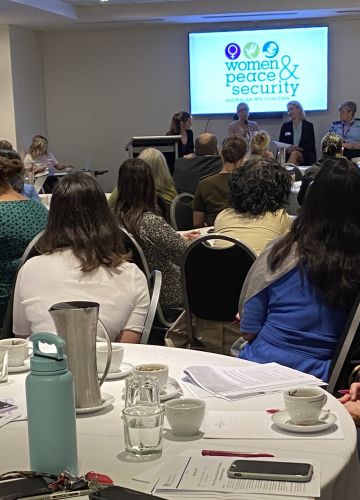
In April 2019 the Australian Civil-Military Centre launched its ‘Women, Peace and Security’ online course.
Civil-Military-Police interaction is the key to improving international response efforts to overseas disasters and conflicts.
National Action Plans on Women, Peace and Security - Eight Countries in Focus
The purpose of this report is to identify the lessons learned and emerging best practices of UN Member States committed to the implementation of this agenda through National Action Plans (NAPs).
Published
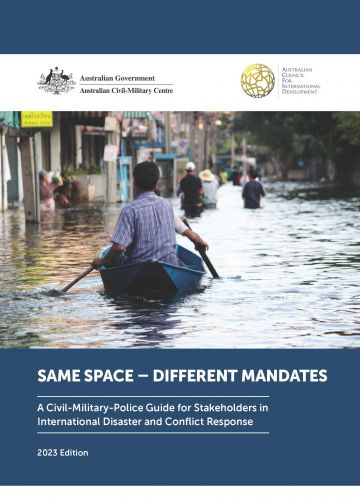
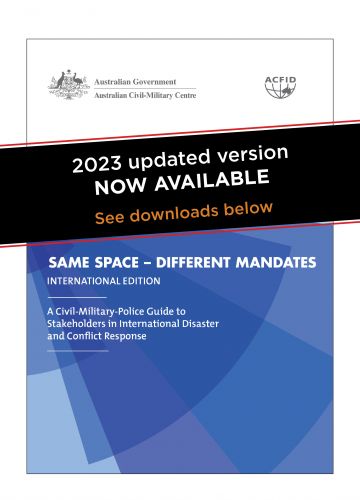
Same Space - Different Mandates
Same Space – Different Mandates aims to improve the collective understanding of civil, military and police stakeholders responding to international disasters and complex emergencies. This revised 2023 edition incorporates emerging concepts and practice to ensure accuracy and future value.
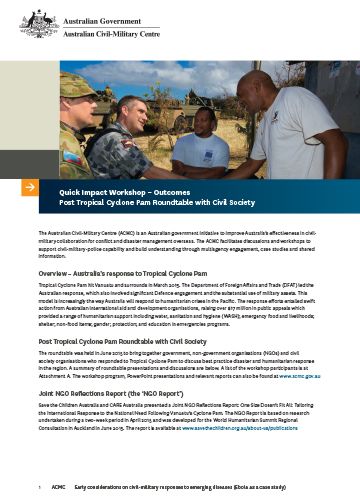
Quick Impact Workshop – Outcomes Early considerations on civil-military responses to emerging diseases - Ebola as a case study
In August 2014, the United Nations (UN) Security Council declared the Ebola virus outbreak in the West African subregion a ‘threat to international peace and security’. The UN’s request for assistance from member states resulted in the mobilisation of technical expertise, medical capacity, humanitarian assistance, and military and civil defence assets.