
A key aspect of the Australian Civil-Military Centre’s (ACMC) Lessons Management Program this year is a major research project to identify recurring lessons from Australia’s civil-military response to domestic and international crises over the last 30 years.
Over the last ten years natural disasters affected more than 2.4 billion people—the equivalent of one-third of the earth’s population—and they have wrought over $910 billion in damages—equivalent to approximately 18 percent of global GDP.
The Australian Civil-Military Centre (ACMC) is following whole-of-government guidance from the Australian Department of Health and the Prime Minister’s Office in relation to COVID-19, and is monitoring the situation with a priority on the health and wellbeing of its staff and of the general community.
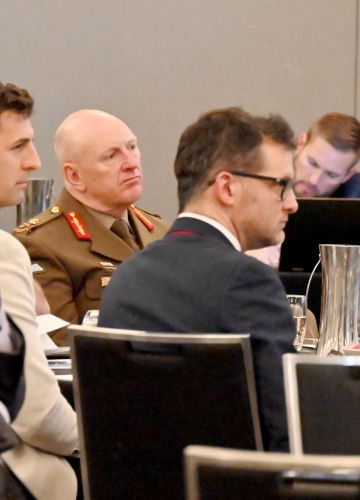
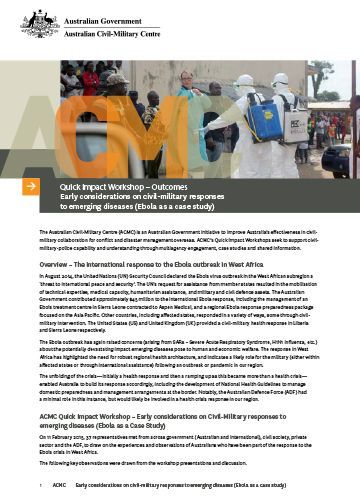
As the pace, scale and complexity of crises continually increases, the Australian Civil Military Centre (ACMC) brought together government, emergency management and non-government experts to share lessons on civil-military interoperability in recent operations.
Over the past two decades, Australia has accumulated considerable experience with whole-of-government missions in complex environments, including in the Solomon Islands and Timor-Leste.
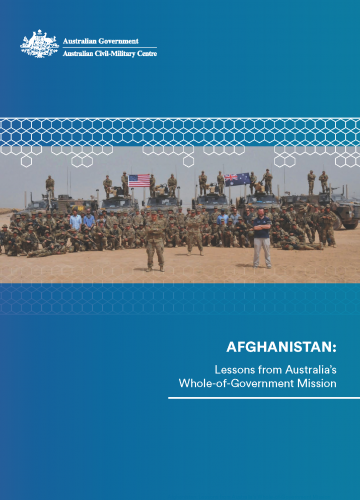
Lessons from Australia’s Whole-of-Government Mission Report commissioned by the Department of Defence, in coordination with the Department of Foreign Affairs and Trade and the Australian Federal Police which outlines the strengths, good practices and challenges of Australia’s mission in Afghanistan at the whole-of-government level.
The increasing scale and frequency of disasters in Australia and our region requires strengthened multi-agency capability to learn from operational experience and embed lessons in future responses.
ACMC learning programs assist government and non-government agencies to develop the knowledge and skills of their people in Civil-Military-Police interaction principles, approaches and related concepts.
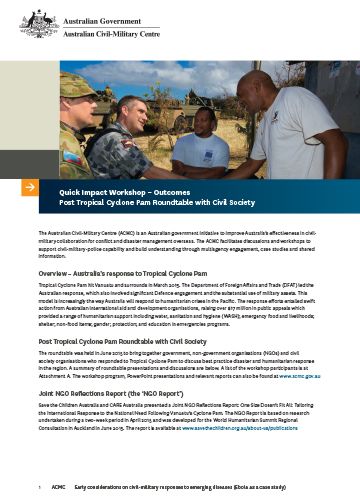
Tropical Cyclone Pam hit Vanuatu and surrounds in March 2015. The Department of Foreign Affairs and Trade (DFAT) led the Australian response, which also involved significant Defence engagement and the substantial use of military assets.