


Responses to catastrophic disasters and complex security challenges in the Indo-Pacific require a coordinated, joined-up response, drawing on broad-ranging civil-military-police expertise.
Published
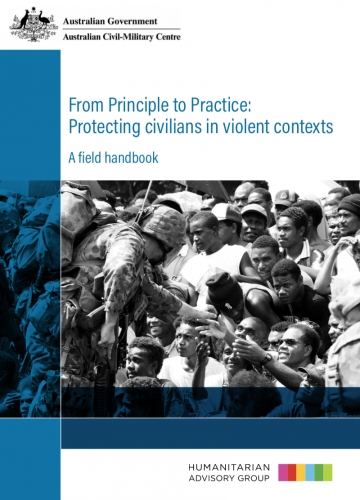
From Principle to Practice: Protecting civilians in violent contexts
Following on from the ACMC Australian Guidelines for the Protection of Civilians (2015) this handbook aims to provide the ‘what’, the ‘why’ and the ‘how’ of protecting civilians in violent contexts and is intended for people working at the operational level including government, NGOs, UN and other organisations.
Article date
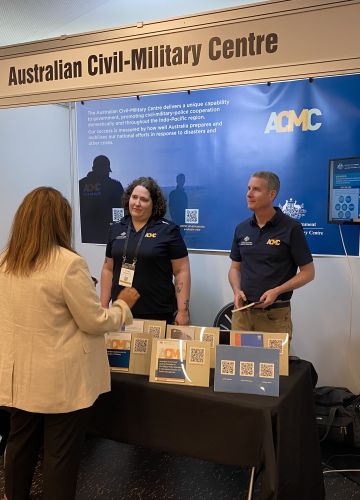
ACMC highlighted its commitment to building civil-military coordination capacity across the Pacific region at the annual Australian Council for International Development (ACFID) annual conference in Sydney.
Published
Short Messaging in Complex Emergencies: A Rapid Guide
The Communication and Complex Emergencies Project is a multi-phase collaboration between the University of Adelaide’s Applied Communication Collaborative Research Unit and the Australian Civil-Military Centre.
Published
ASEAN-Australian Women, Peace and Security Dialogue
The United Nations’ Women, Peace and Security (WPS) agenda has emerged over the past decade and a half as a significant cross-cutting thematic program for achieving global peace and security.
Director, Concepts and Capability
Mr Brian Boulton, AM, CSC
The Concepts and Capability Directorate integrates cross-agency programs on emerging civil-military-police concepts with research and initiatives building capability through preparedness, lessons and evaluation, and humanitarian-government coordination. The Directorate also includes ACMC’s Business Operations and Governance functions.
Published
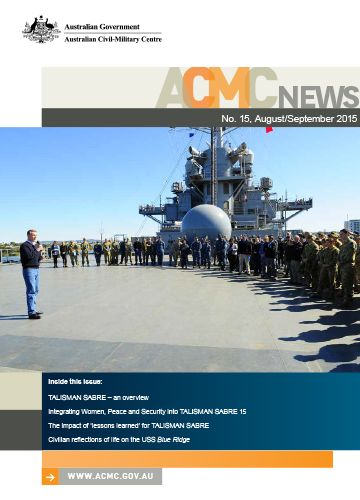
TALISMAN SABRE – an overview
The past decade of operations has taught us that in order to more effectively respond to complex international crises, it is necessary for civil, military and police actors to understand each other and work together in a comprehensive ma
National Action Plans on Women, Peace and Security - Eight Countries in Focus
The purpose of this report is to identify the lessons learned and emerging best practices of UN Member States committed to the implementation of this agenda through National Action Plans (NAPs).

Civil Society Engagement Adviser
Tim Anderson
The ACFID seconded Civil Society Engagement Adviser to the Australian Civil-Military Centre contributes to the advancement of national capabilities to prevent, prepare for and respond more effectively to humanitarian crises through advancements in civil-military-police engagement. Building upon the partnership approach to civil-military-police engagement, the Civil Society Engagement Advisor convenes, facilitates dialogue, and provides policy advice to the stakeholder networks of both ACFID and the ACMC to strengthen understanding of the role, mandate and guiding principles of NGO engagement in humanitarian action.
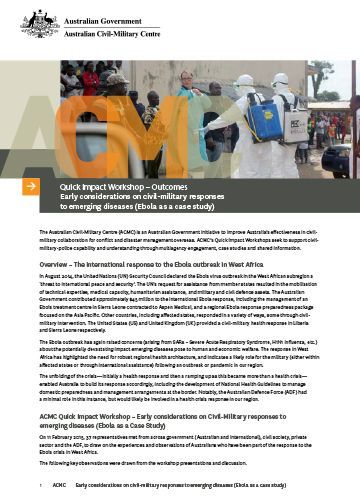
Quick Impact Workshop – Outcomes Early considerations on civil-military responses to emerging diseases - Ebola as a case study
In August 2014, the United Nations (UN) Security Council declared the Ebola virus outbreak in the West African subregion a ‘threat to international peace and security’. The UN’s request for assistance from member states resulted in the mobilisation of technical expertise, medical capacity, humanitarian assistance, and military and civil defence assets.