NGO

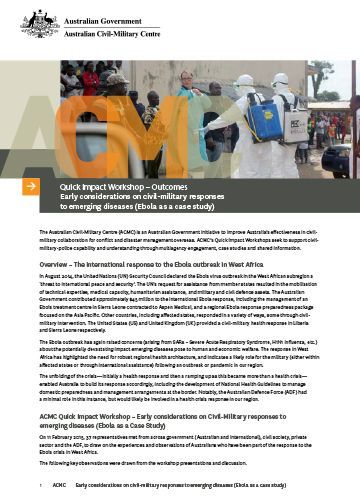
Quick Impact Workshop – Outcomes Early considerations on civil-military responses to emerging diseases - Ebola as a case study

Quick Impact Workshop – Outcomes Early considerations on civil-military responses to emerging diseases - Ebola as a case study

In August 2014, the United Nations (UN) Security Council declared the Ebola virus outbreak in the West African subregion a ‘threat to international peace and security’. The UN’s request for assistance from member states resulted in the mobilisation of technical expertise, medical capacity, humanitarian assistance, and military and civil defence assets.
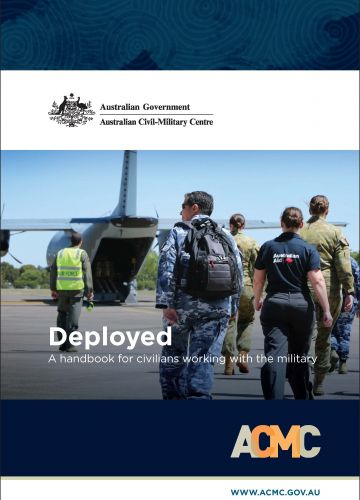
Deployed - A handbook for civilians working with the military

Deployed - A handbook for civilians working with the military

This brief publication is an introduction to the complex business of civil-military-police integration. Hopefully, you will read it prior to an exercise, not an operation. But in either case it provides good advice. Many people have gone where you are going, and this is the distillation of their experience.
Preparing for humanitarian challenges of maritime conflict

Preparing for humanitarian challenges of maritime conflict

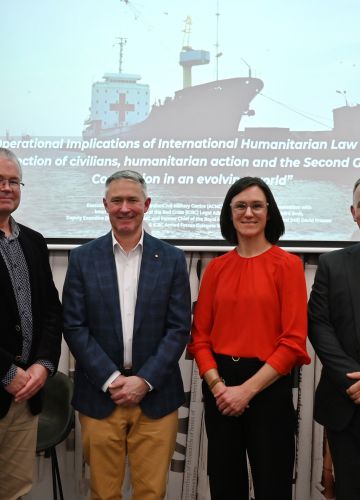
On 23 September 2024, ICRC and ACMC hosted a panel discussion on how to protect civilians at sea during times of conflict. ACMC Executive Directive Nicola Rosenblum moderated the panel, which included ACMC Deputy Executive Director and former Chief of the Royal New Zealand Navy, Rear Admiral (rtd) David Proctor, ICRC Regional Maritime Legal Adviser Andre Smit and ICRC Regional Delegate to the Armed Forces, Snowy Lintern.
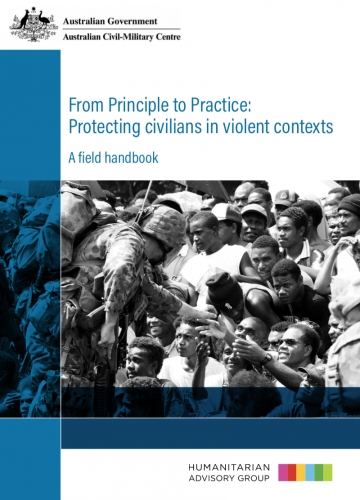
From Principle to Practice: Protecting civilians in violent contexts

From Principle to Practice: Protecting civilians in violent contexts

Lead Author/s
Following on from the ACMC Australian Guidelines for the Protection of Civilians (2015) this handbook aims to provide the ‘what’, the ‘why’ and the ‘how’ of protecting civilians in violent contexts and is intended for people working at the operational level including government, NGOs, UN and other organisations.