Discuss the value of participating in preparedness and training activities.
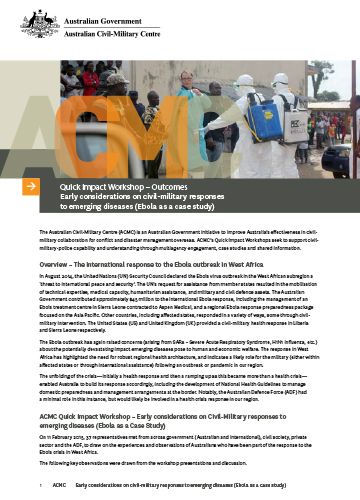
Quick Impact Workshop – Outcomes Early considerations on civil-military responses to emerging diseases (Ebola as a case study)
In August 2014, the United Nations (UN) Security Council declared the Ebola virus outbreak in the West African subregion a ‘threat to international peace and security’. The UN’s request for assistance from member states resulted in the mobilisation of technical expertise, medical capacity, humanitarian assistance, and military and civil defence assets.
What does the future of civil-military-police response effort look like?
Published
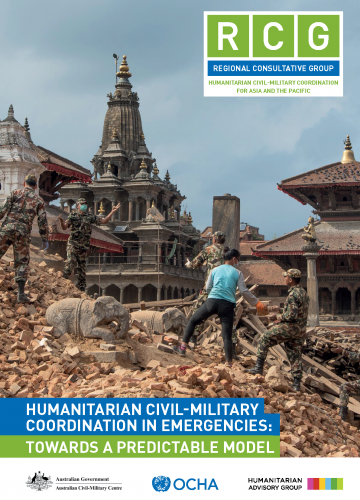
Humanitarian Civil-Military Coordination in Emergencies: Towards a Predictable Model
The Regional Consultative Group (RCG) on Humanitarian Civil-Military Coordination (CMCoord) for Asia and the Pacific is a key forum for supporting and elevating coordination, building relationships, and sharing learning to enhance and strengthen emergency response.
Published
Civil-Military-Police Coordination in Disaster Management: Perspectives from South East Asian countries Research paper and Stakeholder Guide
Responders to natural disasters face increasingly complex operating environments, characterised by new challenges and new actors. Global trends that are overwhelming the international humanitarian system come into sharp focus in South-East Asia.
Published
Women, Peace and Security: Reflections from Australian male leaders
Moving past the theoretical by drawing together the real-life experiences, reflections and lessons of male leaders from the Australian Defence Force, the Australian Federal Police and civilians.
Quick Impact Workshop – Outcomes Post Tropical Cyclone Pam Roundtable with Civil Society
Tropical Cyclone Pam hit Vanuatu and surrounds in March 2015. The Department of Foreign Affairs and Trade (DFAT) led the Australian response, which also involved significant Defence engagement and the substantial use of military assets.
Article date
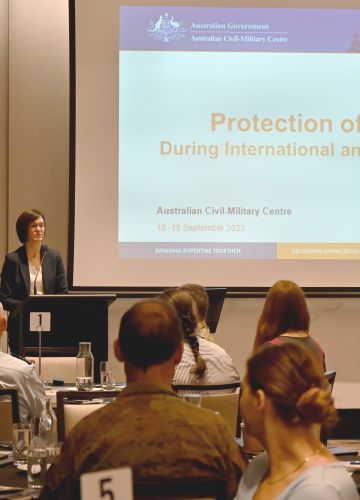
More than 60 participants from across government agencies and civil society considered a range of issues such as how gender impacts protection, the particular risks in urban and maritime warfare, the humanitarian consequences of mis and disinformation, and how cultural property can be better protected.
How does each organisation fit into the broader picture to meet the needs of the communities being served?
Article date
The Australian Civil-Military Centre (ACMC), United Nations Office for the Coordination of Humanitarian Affairs (UN OCHA) and the US Centre for Excellen